Insights
Corporate Brand Films That Get Series B Funded: What Actually Works
A corporate brand film does not get you funded. It compresses the time a room needs to believe you are already the category leader. Here is what actually works.
By Gavin Woodward, Founder. Published June 19, 2026.
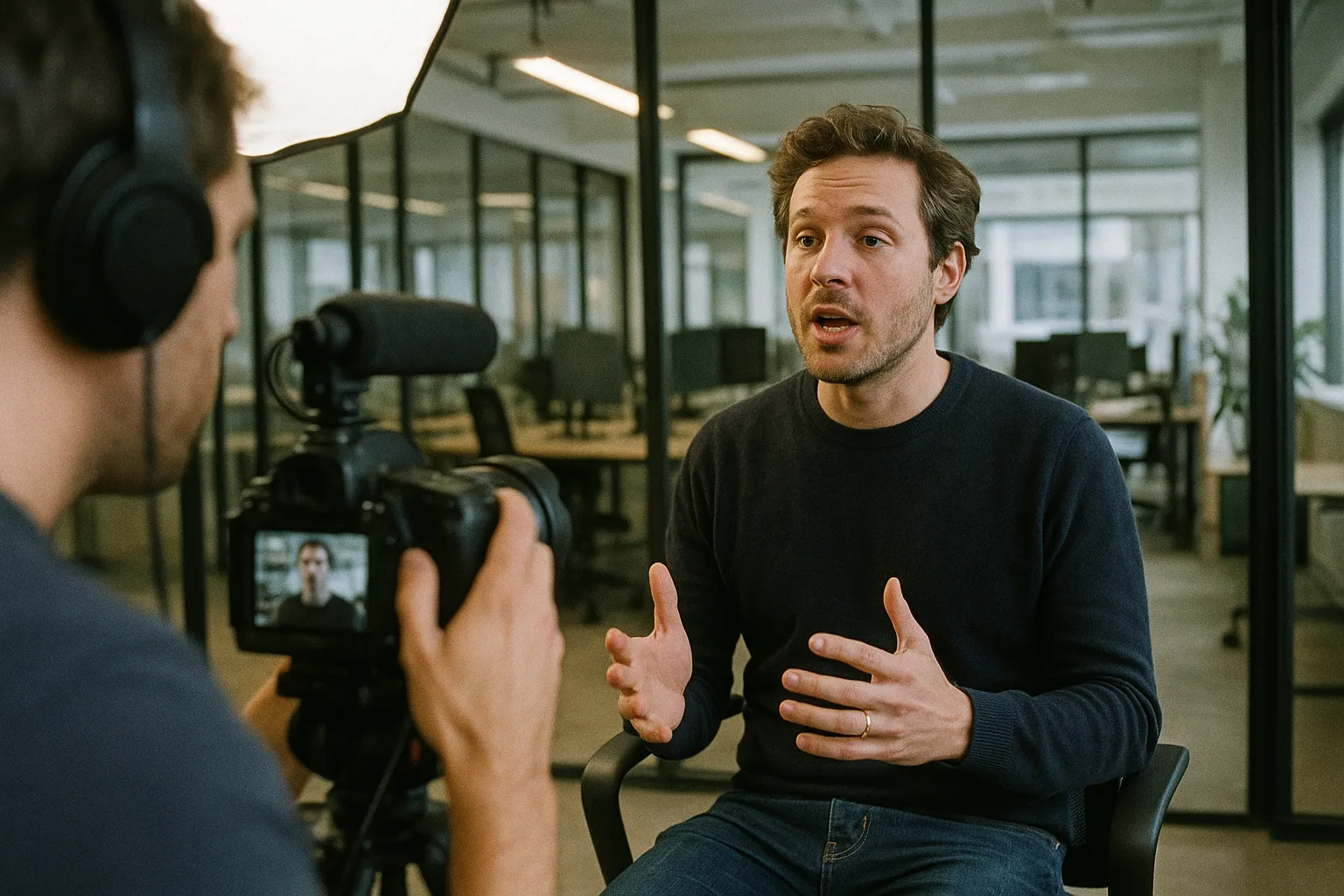
A corporate brand film doesn’t get you funded. The business does that. What a well-made film does is compress the time it takes a room to believe you’re already the category leader. The job is to make that belief arrive in 90 seconds.
That’s the honest frame for this entire piece. Most content ranking for “corporate brand film” promises that video will get you a round. It won’t. When it works, a viewer who knew nothing about your company finishes the cut convinced you’re inevitable. That conviction is worth more at Series B than another feature slide.
So what separates a film that supports a raise from an expensive product montage? Four things, and only four things, do the load-bearing work. The four elements are a category-defining narrative, founder and vision clarity, credible proof of momentum, and production value that signals a company punching above its stage. We’ll walk through each, anchor it in a verifiable example, and then answer the cost question that no competitor publishes.
01 The stage
Why does a brand film matter at the Series B stage?
A brand film matters at Series B because the company is no longer selling a product. It’s selling a category and its own inevitability inside it. Video is the densest medium for that argument. 85% of people say a video has convinced them to buy something, per Wyzowl’s 2026 State of Video Marketing survey, and that persuasion mechanic is exactly what a funding moment needs.
A film is a compression device for belief.
By Series B, the audience changes. Early rounds are sold on the founder and the deck. Later rounds are sold on momentum, category leadership, and the sense that the company is already operating two stages ahead of where it is. A film is the only asset that puts all of that on screen at once: the people, the product running, the conviction in a founder’s delivery, and a production value that quietly says this team doesn’t miss.
There’s a second, quieter reason. The film outlives the announcement. 93% of video marketers say video has improved how customers understand their product, per the same Wyzowl survey. A Series B launch film becomes the top of every sales deck, every recruiting email, and every partner intro for the next 18 months. You’re not buying a one-day asset. You’re buying the company’s default explanation of itself.
To be clear about what we can and can’t claim: there’s no public, verifiable case study of a specific Series B cybersecurity, AI-infrastructure, or enterprise-SaaS launch film that can be sourced as having directly moved a round. We won’t invent one. The argument here rests on named, verifiable examples and on the mechanics of how belief forms in a room.
02 The elements
What are the four elements of a film that supports a raise?
Four elements do the work: a category-defining narrative, founder and vision clarity, credible proof of momentum, and production value that signals a company punching above its stage. Miss any one and you’ve got a pretty video. Hit all four and you’ve got an asset that makes a room lean forward. Each is teachable, and each shows up in films you already know.
A Series B film is not a product tour. It is a compressed argument that you are already the category leader — and all four elements exist to make that argument land in under two minutes.
The four elements, in the order they do their work:
- A category-defining narrative — names the old way and frames your company as the inevitable replacement. An argument, not a description.
- Founder and vision clarity — one human says one true thing with total conviction. The cheapest element to get right, and the most often botched.
- Credible proof of momentum — real traction without overclaiming. Real customer faces and a product running in a real environment beat any number on a slide.
- Production value that signals you are punching above your stage — looks deliberate, not expensive. Frame, light, sound, pacing, and color communicate competence before a word lands.
The short version, before we go deep on each:
| Element | What it does | The failure mode |
|---|---|---|
| Category-defining narrative | Names the old way, frames you as the replacement | A feature tour set to music |
| Founder and vision clarity | One human says one true thing with conviction | A faceless brand-voice montage |
| Credible proof of momentum | Shows real traction without overclaiming | A fabricated metric on a slide |
| Production value as signal | Looks like the category leader already | Polish with nothing underneath |
Notice what’s not on the list: budget. Budget is a means to production value, not the element itself. One of the most-cited startup launch films in history cost less than $5,000. We’ll get to it.
Element one: a category-defining narrative
A category-defining narrative names the old way and frames your company as the inevitable replacement. It’s an argument, not a description. The grammar is consistent across great launch films: here’s the broken status quo, here’s the contrarian bet, here are the world-scale stakes if we’re right. You’re not listing what the product does. You’re staging a worldview.
Apple’s 1984 commercial is the textbook case. Directed by Ridley Scott and produced by agency Chiat/Day, the spot aired during Super Bowl XVIII on January 22, 1984 to herald the Macintosh, which Apple formally unveiled two days later, per History.com. It showed no product features. It staged a fight against conformity and cast Apple as the side of freedom. Apple’s own board initially objected, and the spot became news in its own right.
To be precise about the lesson: Apple wasn’t a Series B startup in 1984, so this is a craft and narrative principle, not a stage-matched case. But the mechanic transfers directly. A cybersecurity company is the unseen guardian in an invisible war. An AI-infrastructure company is building the thing that changes the species. A SaaS challenger is the scrappy team beating a bloated incumbent. You borrow that grammar. You don’t borrow the orange-and-teal blockbuster grade or do literal sci-fi pastiche. Prestige-drama restraint reads as confident. Genre cosplay reads as insecure.
Element two: founder and vision clarity
Founder and vision clarity means one human says one true thing with total conviction. It’s the cheapest element to get right and the most often botched. Investors are pattern-matching for a founder who sees the future clearly and can compress it into a sentence. A film that hides the founder behind stock footage and a brand voiceover throws away its most persuasive asset.
This doesn’t require a famous or charismatic founder. It requires a clear one. One of the most widely imitated launch films of the modern era proves it.
Dollar Shave Club’s 2012 launch video was fronted by founder Michael Dubin himself, and it was followed by roughly 12,000 orders in the first 48 hours, per Inc. Dubin wasn’t famous. He was clear, funny, and certain. That was enough.
Honesty note: Dollar Shave Club is direct-to-consumer, not Series B enterprise tech, so treat it as a principle illustration rather than a vertical match. The principle holds anyway. A founder on camera, saying the contrarian thing plainly, outperforms a polished narrator every time. If your founder is camera-shy, that’s a directing problem we solve in prep, not a reason to cut them.
Element three: credible proof of momentum
Credible proof of momentum means showing real traction without overclaiming. This is where most films either go soft or go dishonest. The fix is the same in both directions: show, don’t assert. Real customer faces, the actual product running in a real environment, named logos you have permission to use. These beat any number on a slide because a viewer can’t fact-check a feeling but can absolutely fact-check a stat.
Dollar Shave Club’s arc is the cleanest public example of momentum compounding from a single film. By June 2015 the company had more than 2 million subscribers and accounted for 13.3% of all razor sales in the U.S., per TechCrunch, momentum that began with the viral launch film. That same month it raised a $75 million Series D at a pre-money valuation above $500 million, per TechCrunch, before Unilever acquired it for a reported $1 billion in 2016.
The rule for your film: every metric must survive diligence. If you put a number on screen, an investor’s analyst will check it within the week. A film that overclaims dies on contact. When you don’t have a clean number yet, don’t invent one. Show the product working and let real users carry the proof.
Element four: production value that signals you are punching above your stage
Production value is the signal that says the company is already operating one stage ahead. It’s not about being expensive. It’s about looking deliberate. Frame, light, sound, pacing, and color all communicate competence before a single word lands. A Series B company that ships a Series A-looking film tells the room it’s behind. One that ships a film with real cinematic weight tells the room it’s ahead.
Now the contrarian part, and it’s the whole reason Emissary exists. Production value used to be bought with logistics: a 20-person crew, an LED volume stage, weeks of scheduling. That’s why a film with real authority cost $85K to $250K. The cost has moved. A hybrid pipeline puts the spend into post, where compositing and generation now produce 8K environments that a physical build could never afford, while live-action capture keeps the human moments real. You can read how that pipeline works on our AI-hybrid approach page.
That shift is what lets a Series B company look like a category leader without a category-leader budget. The 1984 spot needed Ridley Scott and a feature-film budget to signal scale in 1984. In 2026, the signal is achievable for a fraction of that, which changes who gets to look inevitable.
03 The numbers
How much does a corporate brand film cost, and what does the money buy?
A corporate brand film that signals category leadership traditionally costs $85K to $150K with a full crew, or $125K to $250K on an LED volume stage. Emissary delivers that same authority for a flat $40K by moving the cost into post, not logistics. The money buys signal, not gear rental.
A traditional crew charges $85,000 to $150,000 for a brand film with real authority. An LED volume stage runs $125,000 to $250,000. A hybrid pipeline that moves cost into post can deliver the same signal for $40,000 — because logistics no longer set the floor price of looking inevitable.
The published comparison is below. We list it because no competitor does, and because the cost objection is the real one standing between a Series B team and a film that matches its stage.
| Approach | Typical cost | What you are paying for |
|---|---|---|
| Emissary Flagship Launch Film | $40K flat | 90 to 120 second narrative, live-action capture plus 8K AI-composited environments |
| Traditional crew | $85K to $150K | Crew, location, equipment, scheduling, multi-day shoot |
| LED volume stage | $125K to $250K | Virtual production stage, render pipeline, larger crew |
Emissary’s tiers map to the moment. The Executive Sizzle runs $15K to $25K for a 60-second cinematic asset at 3D-grade visual quality. The Flagship Launch Film at $40K is the most-chosen tier and the one most teams build a funding announcement around. The Conference Content System starts at $60K and scopes a keynote opener plus a sales-enablement library as one system. Full pricing lives on the pricing page.
The thesis in one line: a $120K-grade film for $40K, because the authority moves into post. You’re not buying a cheaper film. You’re buying the same signal through a different supply chain.
04 The build
How does the production actually work, and how fast is it?
The production is remote-first and usually delivers a Flagship film in one to two weeks. Emissary ships a roughly $3,000 capture kit to your team, runs a 30-minute prep call over Riverside, and your principals record 10 to 15 minutes of 4K footage locally. The AI-hybrid post then happens internally. No crew booking blocks your announcement date.
A remote-first pipeline removes the single biggest scheduling risk in traditional production: crew availability. When the announcement date is fixed, a one-to-two week delivery window — built around a 30-minute prep call and local 4K capture — means the film never becomes the critical-path blocker.
This matters most when the date is fixed. A funding announcement or a conference keynote doesn’t move because a crew is unavailable. The remote-first pipeline removes the single biggest scheduling risk in traditional production. You’re not coordinating 20 calendars. You’re recording in your own space, on your own day, inside a fixed delivery window.
The pipeline is disclosed per project, not hidden. Capture runs on Sony ZV-E1 bodies, Rode Wireless Pro audio, and Aputure lighting. Compositing uses Higgsfield and Runway. Generation uses Veo 3, Kling, and Sora-grade tools. Voice and lip-sync, when used at all, run on HeyGen and ElevenLabs and are gated behind explicit consent. Every cut carries C2PA content credentials. For a security-conscious buyer, that disclosure is the point.
05 The trust
Will AI in the pipeline undercut an enterprise brand’s credibility?
It won’t, provided provenance is built in rather than bolted on. The risk is undisclosed synthetic media, not AI itself. Emissary’s defaults exist precisely for enterprise legal review: full IP assignment, zero data retention, named-talent consent, a mutual NDA before scoping, and a SOC 2-friendly workflow. Direction comes first, AI second.
The risk is not AI. The risk is undisclosed synthetic media. For enterprise and security-conscious brands, the credibility test is provenance: can a viewer, a legal team, or a diligence analyst verify what was captured versus what was composited? C2PA content credentials make that verification possible — and for brands that sell authenticity, that transparency is a feature, not a concession.
The four trust lines aren’t marketing. They’re the operating constraints. Direction first, AI second means a human directs every frame and AI executes the impossible ones, never the reverse. C2PA provenance in every cut means a viewer or a legal team can verify what’s captured versus composited. Named talent for every face means no synthetic strangers and no likeness ambiguity. Your raw, your composite, your master means you own the full chain.
For a cybersecurity or AI-infrastructure brand, disclosed provenance is a feature. The companies most worried about deepfakes and content authenticity are exactly the ones that should be using C2PA credentials in their own marketing. A film that proves its own provenance models the standard the brand sells. You can see the full compliance posture on our rights and compliance page.
06 No marquee
What about companies without a famous founder or a dramatic origin story?
Most fundable films aren’t built on a famous founder. They’re built on a clear contrarian thesis and honest proof that customers already agree. Dollar Shave Club’s Michael Dubin was unknown before the launch film. The film worked because the argument was sharp and the delivery was certain, not because the founder had a following.
Dollar Shave Club’s Michael Dubin was unknown before the 2012 launch film. The film generated roughly 12,000 orders in its first 48 hours — not because Dubin was famous, but because his argument was sharp and his delivery was certain. Clarity and conviction outperform founder celebrity every time.
The path for a company without a marquee origin story is straightforward. Write one true sentence about why the old way is broken. Put a real person on camera to say it with conviction. Show the product working in a real environment. Carry one honest signal of traction. That structure doesn’t need drama. It needs clarity and restraint, both of which are directing problems, not budget problems.
This is also where the honest framing of Emissary’s own stage matters. Named, stage-matched client case studies are real client work being built as it ships. We’re not going to show you an anonymous “trusted by thousands” badge or a fabricated funding-round case study. The craft is shippable now. The verified case library grows as real work delivers. That’s a more credible promise than the alternative, and it’s the one we make.
The bottom line
A well-made brand film is a compression device for belief. Four elements carry the load: a category-defining narrative, founder and vision clarity, credible proof of momentum, and production value that signals a company operating ahead of its stage. The economic shift is real — a hybrid pipeline now delivers the same signal for $40,000 that once required $120,000 or more in logistics.
A corporate brand film won’t get you funded. Your business does that. What the right film does is compress belief: it makes a room decide you’re already the category leader before you’ve finished the sentence. Four elements carry that load. A category-defining narrative, founder and vision clarity, credible proof of momentum, and production value that signals a company punching above its stage. Apple’s 1984 spot and Dollar Shave Club’s $4,500 launch video prove the craft principles, even though neither was a Series B tech raise. The newer fact is economic. A hybrid pipeline moves cost into post, so the $120K signal now ships for $40K. If a funding moment or a keynote is on your calendar, the film should match the stage you’re claiming. See how the Flagship Launch Film is built on the corporate launch film page, or compare every tier on the pricing page.
Gavin Woodward is the founder of Emissary Studio, with prior brand and commercial film work for Ariat, Nike, Behr Paint, Zig Zag, and FOX.
Frequently asked questions
Does a brand film actually influence investors, or is it just for customers and recruiting?
A film doesn't write the check. The business does that. But a corporate brand film influences investors indirectly by compressing the time it takes a room to believe you're already the category leader. It signals momentum, vision clarity, and execution to customers, recruits, and the partners an investor calls during diligence.
What makes a launch film category-defining instead of just another polished product video?
A category-defining film names the old way, then frames your company as the inevitable replacement. Apple's 1984 spot didn't list Macintosh features. It staged a worldview. The grammar is the contrarian bet, the build, and world-scale stakes, shot with restraint, not a feature tour set to music.
How much should a Series B company spend on a brand or launch film?
Enough to look like the category leader, not so much that logistics eat the budget. Emissary's Flagship Launch Film is a flat $40K for a 90-to-120-second narrative. A traditional crew charges $85K to $150K for comparable authority, and an LED volume runs $125K to $250K.
We do not have a dramatic origin story or a famous founder. Can a brand film still work for us?
Yes. Most fundable films aren't built on a famous founder. They're built on a clear contrarian thesis and credible proof of momentum. You don't need a charismatic origin story. You need one true sentence about why the old way is broken and one honest signal that customers already agree.
How fast can we get a launch film made if our funding announcement or conference date is fixed?
A Flagship Launch Film usually delivers in one to two weeks because Emissary runs a remote-first pipeline. We ship a kit, run a 30 minute prep call, you record 10 to 15 minutes of 4K locally, and the AI-hybrid post happens internally. No multi-week crew booking blocks your date.
How do we show momentum in a film without fabricating metrics or overclaiming?
Show, don't assert. Real customer faces, real product running, real environments beat a number on a slide. If you cite a metric, it must be true and defensible in diligence. A film that overclaims dies the moment an investor checks. Honest proof of momentum is more persuasive than an inflated stat.
Will using AI in production undercut the credibility of an enterprise or security-conscious brand?
Not when provenance is built in. Emissary ships C2PA content credentials in every cut, uses named talent for every face, and gates all voice and lip-sync work behind consent. Direction comes first, AI second. For a security-conscious buyer, disclosed and provenanced AI is a credibility signal, not a liability.
More from Insights
- B2B Video Production Pricing: What a $40K Flagship Film Includes B2B video production pricing, decoded. A $40K Flagship Launch Film would cost $85K to $250K with a traditional crew or LED volume. Here is the line-by-line.
- Best AI Video Production Agency (2026): An Honest Comparison The best AI video production agency depends on whether you need generation or production. An honest 2026 comparison of 8 companies, with pricing and fit.
- What Goes Into a Cinematic Conference Keynote Opener Film A conference keynote opener film is the cinematic stage film that plays right before your CEO speaks. Here's the anatomy, the timeline, and what it really costs.