Insights
What Goes Into a Cinematic Conference Keynote Opener Film
A conference keynote opener film is the cinematic stage film that plays right before your CEO speaks. Here's the anatomy, the timeline, and what it really costs.
By Gavin Woodward, Founder. Published June 19, 2026.
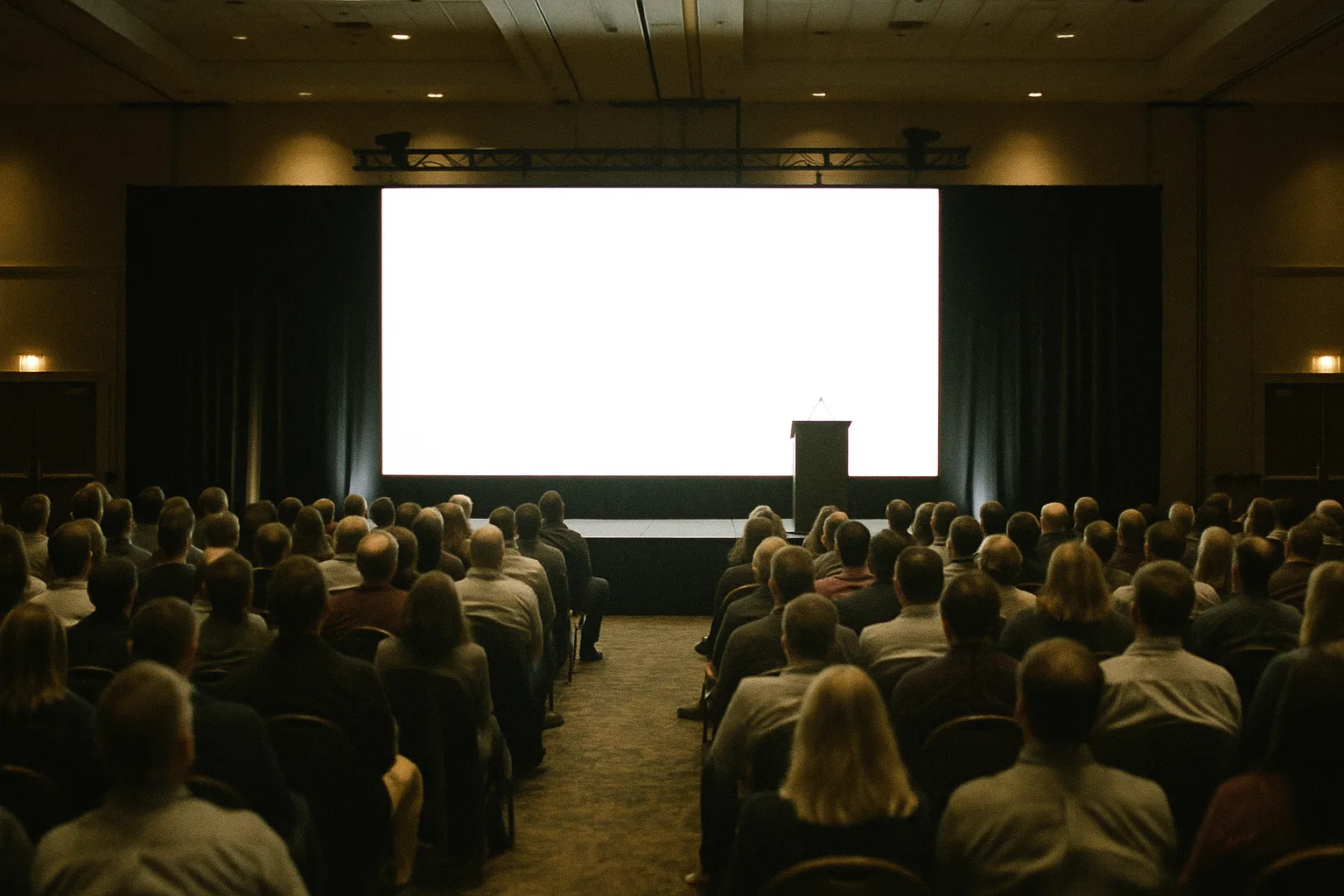
A conference keynote opener film is the cinematic stage film that plays right before your CEO walks out. And it does exactly one thing: it earns the first ninety seconds, and turns a few thousand distracted people into an audience that’s actually looking up. That’s the whole job.
Plenty of people type “keynote opener” looking for slide templates. Let’s clear that up right now: this isn’t Apple Keynote, and it isn’t your deck. It’s the produced film, scaled for a 3,000-person ballroom or a 10K-plus main stage, that gives a room a reason to stop talking. Below, you get the whole picture: the anatomy, how it differs from a sizzle reel, the production timeline, and what it actually costs. All of it. No black box.
01 The basics
Alright, so what is a conference keynote opener film, and what job does it do?
It sets the tone of the room before your CEO speaks. And that’s a bigger job than it sounds. The opener earns the first ninety seconds of attention, frames the whole session, and tells a few thousand half-distracted people that the real content is about to start. It does the warming up so your executive doesn’t have to. So your leader walks out to a room that’s already leaning in. And here’s the part that actually pays: a primed room converts. The buyers in the seats sit warmer to a partnership. The investors sit closer to a yes. And the people who don’t need you today? They walk out remembering exactly who to call. You’re not buying ninety seconds of polish. You’re buying the edge that nudges a room toward the decision you flew everyone in to make.
Earn a feeling in the first thirty seconds, and the next ninety belong to you.
Here’s what no slide can do, and no soundtrack or script can do alone: put picture, score, and story in the room at the same instant, and the senses stop firing one at a time. They fire together. That isn’t decoration. It’s psychology, and it’s why the right film moves a room before a word is spoken. Think about the moment it owns. The lights drop and the room is only half with you. Some people seated, some on their phones, a few still talking in the aisle. Then the film starts, and in under a minute it turns “conference logistics” into “the reason we all flew here.” A weak opener just plays while people keep talking. Same ninety seconds. Opposite outcome.
Every great story works the same way: it makes you care before it asks you to think. Andrew Stanton, the Pixar director behind Finding Nemo and WALL-E, calls the first rule of storytelling “make me care”. A keynote opener lives or dies on that rule. Miss it, and no amount of polish buys the attention back. The work here is emotional and strategic from the very first frame.
Video moves decisions, and the data isn’t subtle.
A keynote opener isn’t a purchase ad. But it runs on the same mechanism. The right film in the right room changes how an audience feels before you make a single claim.
02 Head to head
So how is a keynote opener different from a sizzle reel?
They’re different films with different jobs, scales, and timelines. A sizzle is a short, self-contained hero asset. An opener is a stage-scaled, narrative film built around a live event. Buyers confuse the two constantly. And that confusion goes straight to the budget.
Here’s the clean line between them. An Executive Sizzle is a 60-second cinematic asset built to make one product or one moment look like the category leader’s. We call it the Tactical Wedge. It runs $15K to $25K and delivers in days to weeks. Think of it as your digital salesman. It’s the best-of-the-best highlights of what your company does and why you’re the one to beat, working for you whether it’s on social, in a sales deck, or looping at your booth. It sells the product. No event deadline, no venue to scale to.
A keynote opener is the opposite kind of build. It’s room-opening and narrative, locked to a hard live date. It has to survive an AV-vendor handoff and hold up at the size of the venue screen. Here’s the real difference: the sizzle sells the product, the opener sells the moment. The sizzle shows what you do, who uses it, and why it wins. The opener sets the stage and builds the connection, so the room is already with you before your leader says a word. Different job, different scale, different timeline.
| Dimension | Executive Sizzle | Keynote opener film |
|---|---|---|
| Job | Make one product or moment look category-leading | Open a general session and set the room’s tone |
| Length | About 60 seconds | Stage-scaled, narrative, runs to the show’s needs |
| Built around | An online or sales context | A live event date and venue screen scale |
| Deadline | Flexible | Fixed, immovable show date |
| Delivery | Days to weeks | Engage 8 to 12 weeks out |
| Fee band | $15K to $25K | $50K to $150K, fee-only |
Launching one product to a screen the size of a laptop? Take the sizzle. Opening a room? Take the opener. One sells the product, the other wins the room. They don’t swap.
03 The anatomy
So what actually goes into a keynote opener film?
Three things, really. A story worth watching, your actual leader in the frame, and a look built for the size of the room. Get all three right and the film does what no slide ever will. It makes a few thousand people feel the same thing in the same breath, then carries that feeling straight into your leader’s opening line. The room doesn’t just quiet down. It leans in, and it stays there when the speaker takes over. Get any one of the three wrong, and the film slides back into the same tired formats every conference audience has already sat through too many times.
The three elements every cinematic keynote opener requires:
- A cinematic narrative arc — hook, build, reveal, and brand landing, locked before anyone shoots.
- An executive-named partnership — your actual leader’s voice in the film, recorded on a shipped capture kit.
- Venue-scaled visual design — built for the venue screen from the first frame, not retrofitted after the fact.
The three ways keynote openers fail
We’ve all sat through all three:
- The sterile product demo with a music bed.
- The talking-head deck read aloud to a camera.
- The off-the-shelf stock pack with a logo dropped on the end.
Each one fails the same way: no attention earned, no leader’s voice, no fit with the room. Three swings, three misses. Here’s what we build instead.
A cinematic narrative arc
The arc is what earns the first ninety seconds. Real story structure: a hook, a build, a reveal, a brand landing. Not a feature list set to a stock track. And we lock the arc before anyone shoots, so the opening minute of your event is engineered on purpose, not stitched together in the edit from whatever footage happened to exist.
An executive-named partnership
The film carries your leader’s voice because your leader is actually in it. We build the opener in named partnership with the CMO or VP of Field Marketing, and the executive records their own part. That’s the difference between a film about the company and a film your leader can stand behind on stage, seconds after it ends.
Venue-scaled visual design
The design is built for the size of the screen and the room. A film that looks crisp on a laptop can fall apart on a 60-foot LED wall. And a film built for that wall still has to survive the AV vendor’s processing chain. We design for the venue from the first frame, for 3,000-person conferences and 10K-plus main stages, where the room needs real scale to feel like the event it is.
04 The timeline
What’s the production process and timeline?
Four steps, over an 8-to-12-week window before the show, from executive prep to an onsite AV handoff. Roughly 90% of it is remote-first. Your executive records locally on a shipped kit instead of burning a travel day to fly to a soundstage.
The four steps are simple:
- Discovery and executive prep call. A named partnership with the CMO or VP of Field Marketing. We align on the strategic frame and brief your executive’s on-camera role.
- Scripting and storyboard. The cinematic narrative arc, approved before we shoot. Previs for board approval is built into this phase, so leadership signs off on the arc before a frame of footage exists.
- Live capture and AI-hybrid post. Your executive records on the shipped kit. We build the virtual environments where the room needs scale, then composite the live capture into them.
- Onsite delivery and AV handoff. A broadcast-grade master plus previs cutdowns, fit to your AV vendor’s rig.
On timing: engage 8 to 12 weeks before the show, or 10 to 12 weeks for a sales kickoff. Start earlier if the opener needs board approval or an extra previs round. The capture kit ships straight to your executive, broadcast-quality and simple to run. That’s the whole reason nobody has to leave the building to be in the film.
So where does our job stop and the AV vendor’s start? We make the cinematic film. Your AV vendor runs staging, audio, screens, and the live show. The two jobs sit side by side, and we hand off broadcast-grade masters built for the vendor’s rig. For the full pipeline mechanics, see our AI-hybrid approach.
05 The numbers
What does a cinematic keynote opener cost?
Most cinematic keynote openers land between $50K and $150K, fee-only. A single sales-kickoff opener treated as cinematic content runs $15K to $75K. Full event content systems run $50K to $300K once venue, AV, and production-partner costs are packaged into one number. Where you land comes down to three things: scale, scope, and how many assets come off the same production.
Nearly every event-film vendor hides these numbers behind a contact form. We publish them. Here’s the band by scope:
| Scope | Fee band | What it covers |
|---|---|---|
| Single SKO opener (cinematic content) | $15K to $75K | One opener film for a sales kickoff general session |
| Most cinematic keynote openers | $50K to $150K | A flagship opener for a user conference or summit |
| Conference Content System | $60K and up | The opener plus booth loop, CEO feature, and social cutdowns |
| Full event content system (incl. AV) | $50K to $300K | The film program with venue and production-partner costs packaged in |
The Conference Content System tier is the one most large events reach for, because it scopes the opener film, the booth loop, the CEO feature, the social cutdowns, and AI-scaled personalized sales videos as one system instead of ten separate line items. The full breakdown lives on the pricing page.
06 The economics
How does AI-hybrid make a big-stage look affordable?
It moves the cost into post instead of logistics. That’s the whole trick. And it’s not a small one. Our Emissary Stack pairs live-action capture for the human moments with AI compositing for the impossible ones, so the money goes into the composite instead of flights, hotels, stage rental, and union minimums.
The comparison is the whole argument. A traditional crew runs $85K to $150K-plus: 4 to 6 weeks, a 10-to-15-person crew, and all the travel that comes with them. An LED virtual production volume runs $125K to $250K-plus: 6 to 8 weeks, volume rental, and a real-time Unreal team. The AI-hybrid pipeline delivers a comparable look in days to a couple of weeks. Remote-first.
| Production model | Comparable flagship film | Timeline | What you are paying for |
|---|---|---|---|
| AI-hybrid (Emissary Stack) | $40K (Flagship tier) | Days to 2 weeks, remote-first | Craft and post, not logistics |
| Traditional crew shoot | $85K to $150K-plus | 4 to 6 weeks | A 10-to-15-person crew, travel, and gear |
| LED virtual production volume | $125K to $250K-plus | 6 to 8 weeks | Stage rental and a real-time Unreal team |
The on-screen authority is the same. The only thing that changes is where the work happens. That’s the honest version of the model, and no other event-film vendor will say it out loud: AI-hybrid is the reason a big-stage look costs a third of a traditional crew or an LED volume.
A word on how we run it, because your enterprise legal team will ask. Direction comes first and AI comes second, so the craft layer stays fully intact. Every cut carries C2PA and Adobe Content Credentials provenance. Every face in the film is a named human with a signed consent agreement, and no synthetic likeness appears without one. The tools we use are disclosed in writing, per project. The defaults: full IP assignment and zero data retention. For the full posture, see how we handle rights and compliance.
07 The afterlife
Does the film still work after the event ends?
A keynote opener film with full IP assignment doesn’t retire after the event. The same master re-cuts into sales-enablement clips, LinkedIn reels, recruiting shorts, and paid social units — giving marketing, sales, and recruiting teams a single production that pays out across the calendar year, not just the ninety seconds it owned on stage.
Yes. And this is where the budget quietly pays for itself. Because full IP assignment is the default, you own the master outright, and that one film keeps working long after the room empties. Re-cut it into sales-enablement clips your team sends to warm a deal. Drop the hero moments onto LinkedIn and YouTube, where they keep earning views for months. Pull a thirty-second version for recruiting, a fifteen for paid social, a still frame for the deck. The film that owned the room on day one becomes fuel your marketing, sales, and recruiting teams burn all year. Not for ninety seconds.
That’s also why the system-tier scope makes financial sense. When the opener, the booth loop, the CEO feature, and the social cutdowns all come off one production, you’re not buying ten things. You’re buying one asset that pays out ten ways. That’s the quiet case for treating the opener as an investment, not an expense.
If you want the full economics of how AI-hybrid changes a film budget, the corporate video production cost breakdown runs the same math across every asset type.
Plan your keynote opener
Here’s what the room decides in the first ten seconds: whether to watch, or keep talking. An opener that’s engineered owns that moment. One that’s assembled gets talked over. You get one shot at the first ninety seconds of your event. Get it right.
If you’ve got a general session on the calendar this year, the time to start is now: 8 to 12 weeks out, earlier if the board approves the arc. See the full keynote opener film production page for scope and process, or pull real numbers into your event budget on the pricing page.
Gavin Woodward is the founder of Emissary Studio, with prior brand and commercial film work for Ariat, Nike, Behr Paint, Zig Zag, and FOX.
Frequently asked questions
Is a keynote opener film the same as a sizzle reel, and which one do I actually need?
No, and the difference sets your budget. An Executive Sizzle is a 60-second cinematic asset built to make one product or one moment look like the category leader's, and it ships in days to weeks. A conference keynote opener film is a stage-scaled, narrative film built around a live event deadline, an AV-vendor handoff, and venue screen scale. If you're opening a general session in a room, you need the opener. If you're launching one product online, you need the sizzle.
What does a cinematic conference keynote opener cost?
Most cinematic keynote openers land between $50K and $150K, fee-only. A single SKO opener treated as cinematic content runs $15K to $75K. Full event content systems run $50K to $300K once venue, AV, and production-partner costs are packaged in. Our Conference Content System tier starts at $60K and scopes the opener, booth loop, CEO feature, and social cutdowns as one system instead of ten line items, and you see the number before you commit.
How early do we need to start, and can our executive record remotely instead of flying to a shoot?
Engage 8 to 12 weeks before the show, or 10 to 12 weeks for a sales kickoff. Start earlier if the opener needs board approval or a previs round. Roughly 90% of our process is remote-first, so your executive records locally on a shipped kit, and nobody has to fly to a soundstage.
What is your scope versus our AV vendor, and how do you hand off to their rig?
We make the cinematic film. Your AV vendor runs staging, audio, screens, and the live show. The two jobs sit side by side. We hand off broadcast-grade masters built for the vendor's rig, plus previs cutdowns.
Can the board approve the opener before you shoot it, and can we license the film after the event?
Yes to both, and that's the good news. Previs for board approval is included in the scripting and storyboard phase, so the board sees the arc before anyone shoots. Full IP assignment is the default, which means you own the master and can re-cut and license the opener for sales enablement after the event. The asset works all year, not just for one morning.
How does an AI-hybrid pipeline make a big-stage opener look like a six-figure film without a six-figure budget?
Our Emissary Stack pairs live-action capture for the human moments with AI compositing for the impossible ones. The cost moves into post, not onto flights, hotels, stage rental, and union minimums. A traditional crew runs $85K to $150K and an LED volume runs $125K to $250K. We deliver a comparable look at the $40K Flagship tier, remote-first, in days rather than weeks.
Is a keynote opener about Apple Keynote or presentation software?
No. This isn't Apple Keynote, and it isn't your slide deck. A conference keynote opener film is the cinematic stage film that plays in the room right before the keynote speaker walks out. If you searched for a stage opener, a general session opener, or a show opener, you're in the right place. Those are all the same job. And if you want the actual keynote deck and slides built too, we can produce those alongside the film, so the presentation and the opener feel like one piece.
More from Insights
- B2B Video Production Pricing: What a $40K Flagship Film Includes B2B video production pricing, decoded. A $40K Flagship Launch Film would cost $85K to $250K with a traditional crew or LED volume. Here is the line-by-line.
- Best AI Video Production Agency (2026): An Honest Comparison The best AI video production agency depends on whether you need generation or production. An honest 2026 comparison of 8 companies, with pricing and fit.
- Corporate Brand Films That Get Series B Funded: What Actually Works A corporate brand film does not get you funded. It compresses the time a room needs to believe you are already the category leader. Here is what actually works.