Insights
SaaS Brand Films vs Product Demos: A SaaS Video Production Guide
A SaaS brand film primes the 95% of buyers not in-market; the product demo converts the 5% who are. Here is the decision rule for SaaS video production.
By Gavin Woodward, Founder. Published June 19, 2026.
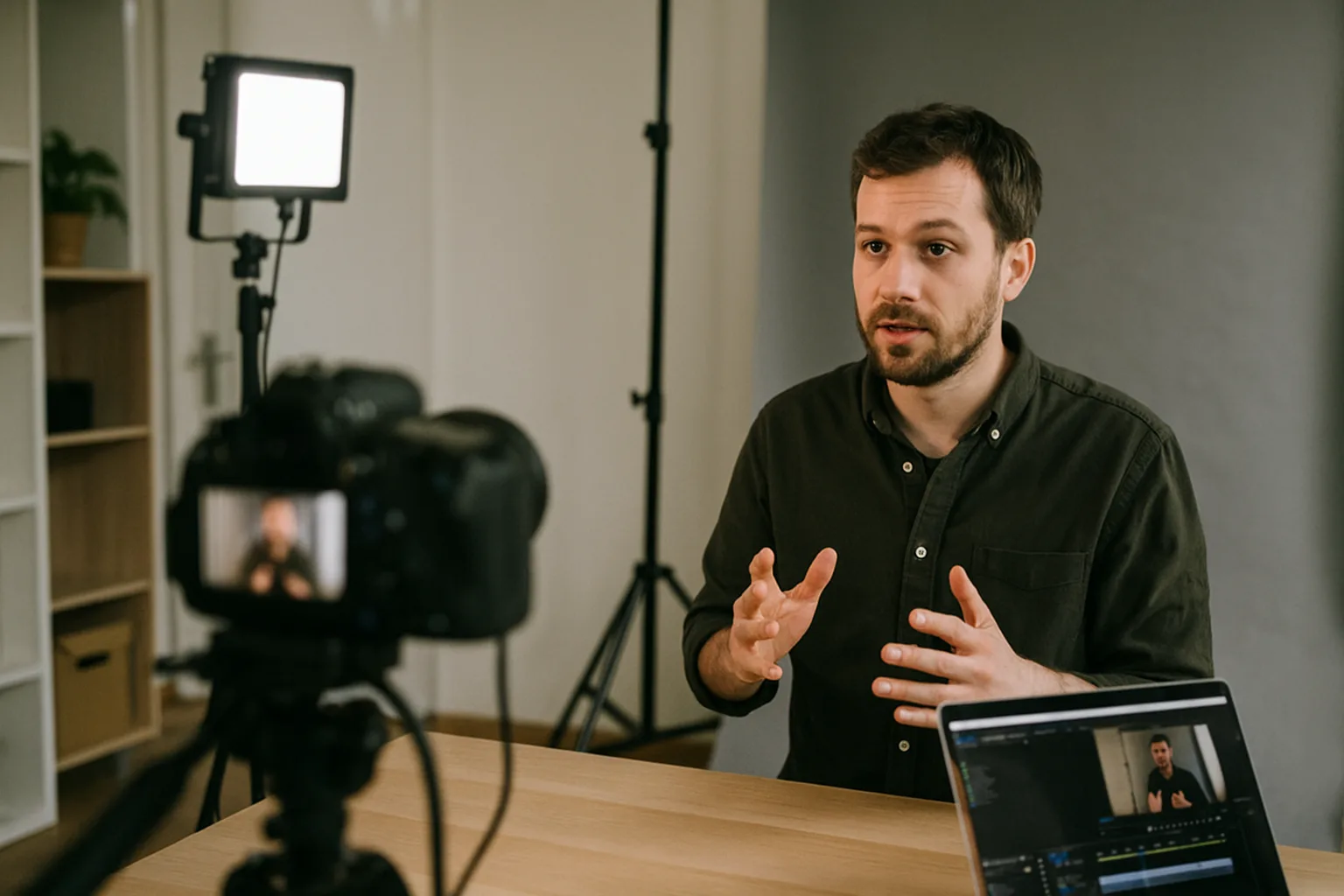
A SaaS brand film and a product demo aren’t two versions of the same video, and getting saas video production right starts with knowing which is which. The brand film sells why your category exists and why buyers should care: the emotional, top-of-funnel asset. The product demo makes the software legible, converting the in-market buyer mid-funnel. You need both, and you can shoot them once.
That distinction is where most saas video production goes wrong. Teams commission “a video,” get a feature walkthrough, and wonder why it never moved the brand. Below is the decision rule, grounded in buyer-behavior science, plus the cost math that lets a Series B company afford the cinematic end of the spectrum.
01 The split
What is the difference between a brand film and a product demo?
A brand film argues for your category and your right to lead it. A product demo argues for your features and how they work. The split matters because of buyer timing.
Only about 5% of B2B buyers are in-market and ready to buy at any moment. The rest won’t buy for months or years. Each video targets a different group, and that’s the whole reason you can’t collapse them into one.
The brand film talks to the 95%. It’s built on emotion, story, and a claim about why your category should exist. Often there’s no product UI on screen at all. Salesforce did exactly this with “Soar: A Salesforce Philanthropy Film”, a brand piece with zero feature list and zero interface. That’s a SaaS company spending on emotion and category instead of a how-it-works walkthrough.
The product demo talks to the 5%. It shows value fast, ideally in about 90 seconds instead of listing features for nine minutes. Pipedrive’s product video, as cataloged by Wyzowl, uses whimsical characters to guide viewers through the sales platform: the how-it-works counterpoint to the Salesforce brand film. Both are good. They just do different jobs.
The two video types serve opposite ends of the buyer journey:
- Brand film — targets the 95% out-of-market; leads with emotion, story, and a category claim; often shows no product UI at all.
- Product demo — targets the 5% in-market; makes the software legible in roughly 90 seconds; shows workflow, UI, and the how-it-works proof.
Brand film: emotion, category, why you exist
A brand film answers the question a buyer can’t Google: should this category exist, and is this company the one to lead it? It runs on narrative and human moments, not screenshots. Grammarly’s brand-leaning video, also cataloged by Wyzowl, uses live-action footage of real people with no voiceover, emphasizing authentic communication over a UI tour. The job is memory and meaning, not clicks.
Product demo: features, workflow, how it works
A product demo answers a narrower question: will this software solve my problem, and how? It earns its keep late in the funnel. B2B buyers who view nine or more product demos close at roughly 8 to 10 times higher rates than buyers who watch none, and product experiences surface four or more stakeholders on average, drawn from analysis of about 6 million buyer interactions by Consensus. Zendesk’s narrative video, cataloged by Wyzowl, shows you can lead with story even when the job is to make a product legible.
02 The decision
When should you use a brand film vs a product demo?
Use the brand film for the category claim and the launch moment. Use the product demo to make the software legible mid-funnel. That’s the whole decision rule. The science behind it is the 95:5 split: the demo converts the 5% in-market today, and the brand film primes the 95% who aren’t, so you’re remembered when they enter the market, per Ehrenberg-Bass.
Here’s the practical mapping for a Series B SaaS team. In sequence, the buyer journey looks like this:
- Out-of-market phase (95% of buyers) — brand film runs here; homepage hero, launch video, conference keynote; goal is memory and category claim.
- In-market evaluation phase (5% of buyers) — product demo runs here; product page, pricing page, sales deck; goal is proof and close.
- Post-evaluation — demo cutdowns and sizzle reels support the sales rep through the internal socializing stage.
| Decision factor | Use a brand film | Use a product demo |
|---|---|---|
| Buyer state | The 95% out-of-market | The 5% in-market |
| Funnel stage | Top of funnel | Mid and late funnel |
| Core job | Prime memory, stake the category claim | Make the product legible, drive close |
| What is on screen | People, story, the why | Workflow, UI, the how |
| Primary moment | Launch, keynote, homepage hero | Product page, pricing page, sales deck |
| Buyer question it answers | Should this category exist, and why you? | Will this solve my problem, and how? |
The two aren’t competitors for budget. They’re partners across the funnel. The brand film launches the category claim, the moment the whole company is built around at Series B, C, or D. The product demo makes the product legible right when an interested buyer is evaluating you against two other vendors.
The funnel map: which video goes where
Top of funnel is the brand film’s territory: the launch video, the keynote opener, the homepage hero, the conference reel. These are the assets that decide whether anyone remembers you in six months.
Mid and late funnel is the demo’s territory: the product page, the pricing page, the sales-enablement clip a rep drops into an email. This is where the in-market buyer needs proof of how the software works before they socialize it internally, and where viewing more demos correlates with dramatically higher close rates.
The decision rule in one line
One line: brand film for the claim, demo for the proof, both from one shoot. If a single piece has to do only one job well, that’s your signal you need two pieces, not one compromised video trying to be both.
03 Both, not one
Why does a Series B SaaS need both, not one?
A Series B SaaS needs both because no single video can prime the 95% and convert the 5% at once. The math is structural. Optimal long-term B2B investment splits roughly 60% to brand building and 40% to activation, per Les Binet and Peter Field’s The Long and the Short of It, and the 95:5 in-market dynamic is the reason that split holds. Skip the brand film and you starve the 60% that compounds.
Adoption isn’t the problem. 91% of businesses use video as a marketing tool, 82% of marketers say video gives a good ROI, and 83% of video marketers say video has directly increased sales, per Wyzowl’s 2026 survey of 266 respondents. Almost everyone ships video. Most of it is the same demo, doing the 5% job, while the 95% job goes unfilled.
That gap is the opportunity. In our experience working with launch teams, the company that primes the out-of-market 95% with a memorable category claim is the one that gets the inbound call when those buyers finally enter the market. A demo can’t do that work. It was never built to.
The sameness problem nobody admits
Open ten Series B SaaS sites and you’ll watch the same video ten times. The same isometric UI float. The same upbeat library track. The same three smiling people at the same standing desk. That’s the reason most product demos get closed at the two-second mark.
Sameness is the real competitor.
Cinematic craft is the one thing that keeps a buyer’s tab open. A brand film that looks like a launch trailer, not a template, signals category leadership before a single word lands. That signal is hard to fake and hard to copy, which is exactly why it works.
04 The numbers
How much does SaaS video production cost, and what does a launch-grade brand film run?
Anchor the budget to the 60:40 split: roughly 60% of long-term spend to brand building and 40% to activation, per Les Binet and Peter Field’s The Long and the Short of It. For the brand-building line, the question is what launch-grade authority actually costs. At Emissary, the Flagship Launch Film is a flat $40K. The same authority through legacy production runs far higher.
The reason the price can be that low is mechanical. The heavy lifting moves into post, not onto the invoice. A traditional 10 to 15 person crew over four to six weeks bills $85K to $150K. An LED virtual production volume over six to eight weeks bills $125K to $250K or more. The Emissary Stack captures the human moments live, then builds the impossible ones in AI compositing, so you pay for a $120K-grade film at $40K.
| Production path | Typical cost | Typical timeline |
|---|---|---|
| Emissary Executive Sizzle (60s) | $15K to $25K | A few days |
| Emissary Flagship Launch Film (90 to 120s) | $40K flat | A week or two |
| Emissary Conference Content System | $60K+ | Scoped as one system |
| Traditional crew (10 to 15 people) | $85K to $150K | 4 to 6 weeks |
| LED virtual production volume | $125K to $250K+ | 6 to 8 weeks |
Full pricing and tier detail live on the Emissary pricing page. The point for budgeting is simple: launch-grade brand film is no longer the line item you defer until Series D. At a flat $40K, it fits inside the 60% brand allocation a Series B should already be running.
One shoot, ten assets, a year of distribution
Here’s the efficiency most teams miss: the brand film and the product-demo cutdowns can come from one production. You pay once for principal capture, then split the funnel-specific versions out in the edit instead of booking two separate shoots.
The whole process is remote-first. Contract and shoot window, a pro kit shipped to you, a 30-minute prep call on Riverside, then you record 10 to 15 minutes locally in 4K. From there the AI-hybrid post pipeline handles compositing, 8K environments, edit, and sound, with delivery in days to weeks and unlimited minor revisions in the first five days. When a lighting pro in the room is warranted, an onsite hybrid add-on runs $8K to $15K.
05 The craft
How do you keep an AI-hybrid film from looking like every other SaaS video?
You keep it distinctive by putting direction first and AI second. AI is the engine, not the deliverable. The Emissary Stack captures real human moments with real gear, then uses generation and compositing only for shots a camera can’t get. Direction, story, and the cut stay human on every film, which is what separates a launch trailer from a template.
An AI-hybrid SaaS brand film avoids sameness the same way any great film does: through direction, story, and a clear point of view. The technology is infrastructure. What keeps a buyer’s tab open is cinematic craft and a category claim no competitor has made yet.
The pipeline is disclosed per project, not hidden. Capture runs on Sony ZV-E1, Rode Wireless Pro, and Aputure lighting. Compositing uses Higgsfield and Runway. Generation uses Veo 3, Kling, and Sora-grade tools. Voice and lip-sync use HeyGen and ElevenLabs, consent-gated only. Every cut carries C2PA / Adobe Content Credentials provenance, so the make of each frame is auditable.
That auditability matters for enterprise buyers. The defaults are built for legal review: full IP assignment (your raw, your composite, your master), zero data retention, a mutual NDA available before scoping, named-talent likeness consent, and a SOC 2 friendly posture. The compliance detail is documented on the rights and compliance page. Named talent for every face isn’t a tagline. It’s a contract default.
Brief the right video, in the right place
The single most common SaaS video mistake is briefing “a video” instead of briefing a job. The brand film and the product demo are different briefs, different lengths, and different placements — but they can come from the same shoot, which is where the efficiency lives.
Stop briefing “a video.” Brief the job. The brand film stakes your category claim to the 95% who aren’t buying yet. The product demo converts the 5% who are. Run both, ideally from one shoot, and you cover the full funnel instead of half of it.
For a Series B team, the cost objection is gone. A launch-grade brand film is a flat $40K through the AI-hybrid Emissary Stack, with full IP assignment and C2PA provenance in every cut. See how the model produces brand films and demo cutdowns from a single shoot on the SaaS video production page, or compare tiers on the pricing page.
Gavin Woodward is the founder of Emissary Studio, with prior brand and commercial film work for Ariat, Nike, Behr Paint, Zig Zag, and FOX.
Frequently asked questions
What is the difference between a SaaS brand film and a product demo, and do we really need both?
A brand film sells why your category exists and why you exist inside it. It runs on emotion, story, and a category claim. A product demo makes the software legible, showing value in roughly 90 seconds instead of listing features for nine minutes. You need both because they do different jobs in different parts of the funnel, and they can come from a single shoot.
If 95% of our buyers are not in-market right now, isn't a product demo a waste, or is it the other way around?
Neither is a waste. The product demo converts the roughly 5% of B2B buyers who are in-market today, per Ehrenberg-Bass research for the LinkedIn B2B Institute. The brand film primes the other 95% who won't buy for months or years, so your name is the one they remember when they finally enter the market.
Where in the funnel does each video work?
The brand film belongs on the homepage hero, the launch announcement, and the keynote opener, the top-of-funnel moments where you stake a category claim. The product demo belongs on the product page, the pricing page, and inside the sales deck, where an in-market buyer needs to see exactly how the software works before they bring it to their team.
How much should a Series B SaaS spend on a brand film versus product demos, and what does a launch-grade brand film actually cost?
A useful planning anchor is the 60:40 split: roughly 60% of long-term budget to brand building, 40% to activation, per Les Binet and Peter Field. At Emissary, a launch-grade Flagship brand film is a flat $40K. A traditional crew version of the same authority runs $85K to $150K, and an LED volume version runs $125K to $250K or more.
Can we get a brand film and the product-demo cutdowns from a single production instead of paying for two separate shoots?
Yes. That's the core efficiency of the model: one shoot, ten assets, a year of distribution. The brand film and the demo cutdowns run through the same capture session and the same AI-hybrid post pipeline, so you pay once for principal capture and then split out the funnel-specific versions in the edit.
How do we know an AI-hybrid brand film will look launch-grade and not like the same isometric-UI video every other SaaS company ships?
Because direction comes first and AI second. The Emissary Stack captures real human moments live, then uses AI compositing only for the impossible shots. Open ten Series B SaaS sites and you watch the same isometric UI float ten times. Cinematic craft, not a stock template, is the thing that keeps a buyer's tab open.
What about IP, AI tooling, and our security and legal review: who owns the footage and is the pipeline auditable?
You get full IP assignment: your raw, your composite, your master. Defaults include zero data retention, named-talent likeness consent, a mutual NDA available before scoping, and C2PA provenance in every cut. The pipeline is built for enterprise legal review and is SOC 2 friendly, so your security team can audit how each frame was made.
More from Insights
- B2B Video Production Pricing: What a $40K Flagship Film Includes B2B video production pricing, decoded. A $40K Flagship Launch Film would cost $85K to $250K with a traditional crew or LED volume. Here is the line-by-line.
- Best AI Video Production Agency (2026): An Honest Comparison The best AI video production agency depends on whether you need generation or production. An honest 2026 comparison of 8 companies, with pricing and fit.
- What Goes Into a Cinematic Conference Keynote Opener Film A conference keynote opener film is the cinematic stage film that plays right before your CEO speaks. Here's the anatomy, the timeline, and what it really costs.