Insights
Sales Kickoff Opener Film: A Series B Production Playbook
A production playbook for the sales kickoff opener film: what it must do, when to engage a studio, and how to turn one SKO into a year-long content system.
By Gavin Woodward, Founder. Published June 19, 2026.
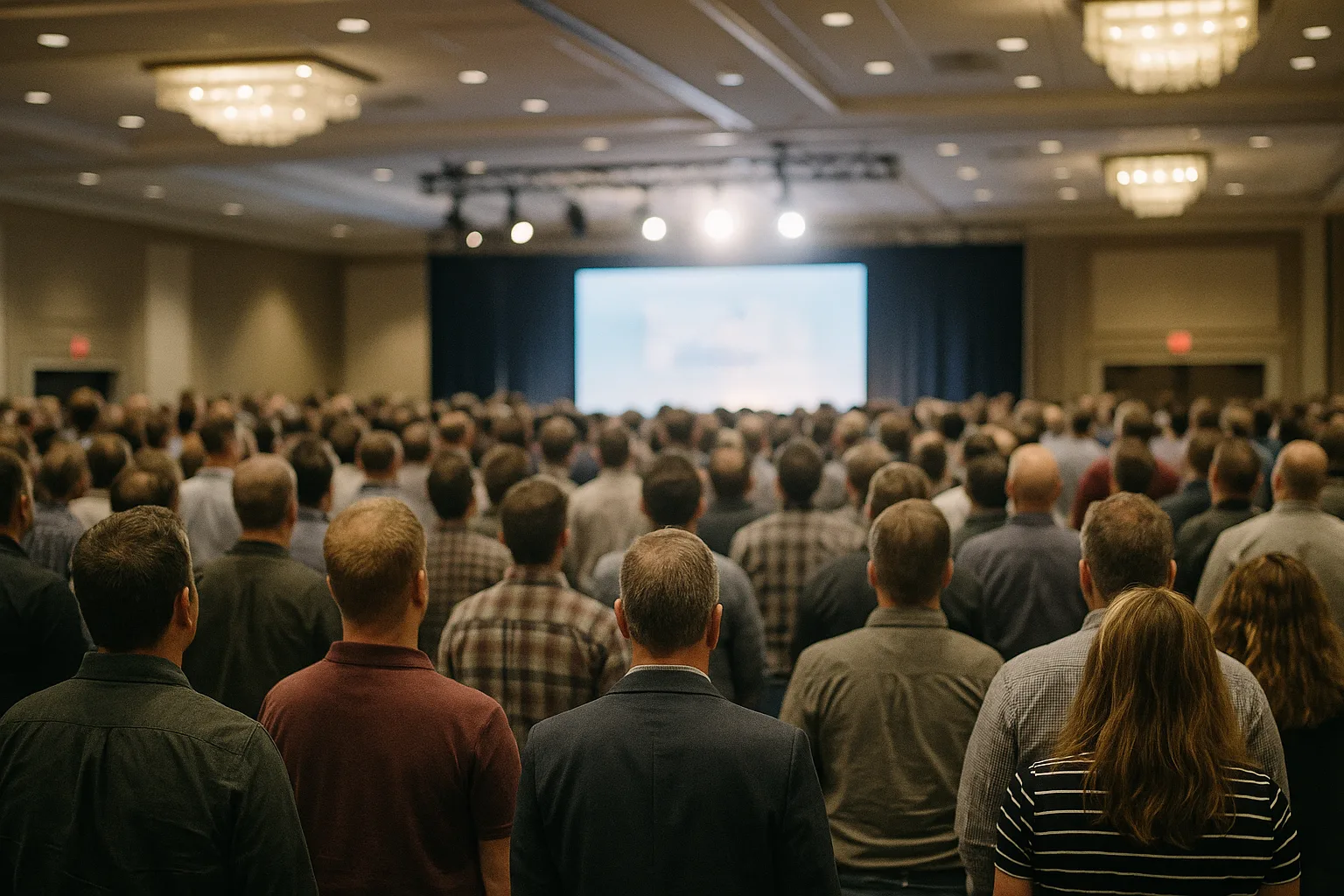
A sales kickoff opener film is the cinematic short that plays right before your CEO takes the stage. Its job is narrow and high-stakes: energize the room, align the team on the year’s strategy, and carry the theme that threads through every session. Treat it as a content asset instead of a one-night expense, and it works all year. Not just for one night.
01 The basics
What is a sales kickoff opener film?
A sales kickoff opener film is the cinematic content that opens an SKO general session, not the stage that content plays on. It’s the hero asset of your kickoff. It sets the emotional and strategic tone of the room before any executive speaks, and it visually establishes the theme the rest of the event builds on.
This is a real enterprise deliverable, not a boutique nicety. Microsoft pays a production studio to open its largest sales and partner gatherings. CG Creative Studios produced the opening performance and general-session content for Microsoft’s MGX Global Exchange and related global partner meetings, with one annual keynote production for 4,800 field sellers, per the studio’s client page. That’s the category. The question for a Series B company isn’t whether the opener matters. It’s how to get that authority without a full-crew budget.
A note on language. We call this the sales kickoff opener film. You may also hear keynote opener or general session opener, the universal cross-event terms. We avoid “show opener” and “sizzle reel” on purpose. One reads as AV-vendor stage language. The other reads as freelancer. The film is neither.
How an opener film differs from the AV and staging vendor
The opener film and the AV vendor are two different scopes. We do cinematic content. The AV vendor does staging, lighting, sound, and the screens at the venue. You typically need both. The mistake is assuming the company that builds your stage is also the right team to make the film that plays on it. Stage build and cinematic storytelling are different crafts.
02 The job
What does an SKO opener film actually have to do?
An SKO opener film has three jobs, and a good one does all three at once. It energizes the room before the CEO speaks. It aligns the team on the year’s strategy. And it carries the theme visually, so the message threads through every session. Miss any one of those and you’ve got a video, not an opener.
The why behind this is unglamorous: people forget fast. Faster than any SKO planner wants to admit.
The curve goes back to Hermann Ebbinghaus in 1885, and modern replication holds the line: roughly two-thirds gone within a day, and most of the rest within a week. Apply that to a one-night general session. The keynote that felt electric on Tuesday is mostly gone by the following Tuesday. The film is your best shot at making the message stick, and your best shot at reinforcing it after the lights come up.
Job one: energize the room before the CEO speaks
The opener’s first job is tonal. It sets the tone of the room before the CEO speaks. Reps walk in cold, distracted, half on email. The film’s job is to take that room and unify its attention in 90 seconds, so the CEO walks into energy instead of building it from scratch. This is craft work: pacing, music, image, restraint. It isn’t about volume.
Job two: align the team on the year’s strategy
The second job is strategic. An opener has to make an abstract plan feel concrete and shared. A new market, a repositioned product, a number everyone has to hit. Film does this better than a slide because it shows rather than tells. The AI-hybrid pipeline matters here, because it lets us visualize things that don’t exist yet: a product roadmap, a customer’s future, a market you’re about to enter.
Job three: carry the theme through the whole event
The third job is connective. Most SKOs adopt a theme. The opener is where that theme gets its visual language: the palette, the motif, the line that recurs. When breakout sessions, slides, and the closing reel all echo the opener, the event feels designed instead of assembled. The film becomes the spine of the production, not a standalone clip.
03 The timeline
How early should you engage a studio before your SKO?
Engage 8 to 12 weeks before the show. That window covers scripting, remote capture, AI-hybrid post, and a full revision cycle without a rush premium. Shorter timelines are possible, but they compress the creative work that makes an opener feel intentional instead of generic. Earlier is better if you want more than the opener.
An 8-to-12-week lead gives you scripting, remote capture, AI-hybrid post, and a full revision cycle — all without a rush premium. Compress that window and you trade creative quality for logistics speed.
The longer lead time pays off when you scope a content system instead of a single film. Product films, explainers, and an enablement library all draw from the same capture and the same pipeline. Decide that early and one shoot feeds ten assets. Decide it late and you’re stitching separate projects under deadline. We can also produce onsite during the event itself, capturing and editing live for next-day delivery, a different and complementary workflow.
04 The economics
Why reframe the opener as a content system, not a one-off?
Reframe it because the economics demand it. B2B event budgets aren’t growing. Forrester’s Q1 2025 State of B2B Events Survey found budgets were flat or down for two-thirds of event teams, for the second consecutive year. You can’t get more money. You can only make the money you have last longer.
A sales kickoff content system is the answer. Instead of buying a one-night opener, you scope the opener, product films, architectural explainers, and a sales-enablement library as one project. The opener is the hero asset. The rest is reusable content that works all year. The spend stops being a one-night expense and becomes an owned asset that supports every quarter after the kickoff.
One shoot. Ten assets. A year of distribution.
This is the Conference Content System tier, which starts at $60K. It exists precisely because a single opener leaves value on the table. The same remote-first capture and the same AI-hybrid pipeline that produce the hero film also produce the cutdowns, the product spots, and the enablement reels your team replays for the rest of the year.
The budget math, plainly
Here’s the reframe in dollars. A physical SKO for 200 reps burns $500K to $800K and is half-forgotten in a fortnight. Reallocate 15% of it and you own a sales-enablement engine that works all year. Fifteen percent of that range is $75K to $120K, which lands squarely in the Conference Content System band.
That framing holds up against outside benchmarks. Sales Benchmark Index observed a fully loaded SKO running roughly $2,500 to $5,500 per attendee in 2021, so a 100-rep event is about $270K to $640K. A separate Prospeo planning template splits a typical budget into venue and hotel at 35 to 40%, travel at 20 to 25%, and catering at 15 to 20%, leaving AV and production, the only line that can survive the event, at just 10 to 15%.
| SKO budget line | Share of total spend | Survives the event? |
|---|---|---|
| Venue and hotel | 35 to 40% | No |
| Travel | 20 to 25% | No |
| Catering | 15 to 20% | No |
| AV and production | 10 to 15% | Partially |
| Filmed content system | reallocate ~15% | Yes, works all year |
Sources: the per-attendee range is Sales Benchmark Index 2021 observed data; the budget-split percentages are from a Prospeo planning template, not SBI. The $500K to $800K planning figure is Emissary’s own framing for a 200-rep SKO, not an externally measured statistic.
05 The build
How do you get cinematic authority without a full crew?
You move the cost into post, not logistics. By the bands we scope against, flagship-grade cinematic authority costs $85K to $150K with a traditional crew, or $125K to $250K on an LED volume. Emissary delivers a comparable result for a fraction of that, because the expensive work happens in compositing and generation rather than on a set with travel, gear trucks, and a 20-person crew.
The mechanism is the Emissary Stack, our AI-hybrid pipeline, and we disclose the tools in writing per project. Capture runs on a remote-first kit: Sony ZV-E1, Rode Wireless Pro, Aputure lighting. Compositing happens on Higgsfield and Runway. High-resolution generation uses Veo 3, Kling, and Sora-grade models. Voice and lip-sync, when used, run on HeyGen and ElevenLabs, consent-gated only. This isn’t fringe technology. Forrester’s same Q1 2025 survey found AI for content creation is now the number-one current use case among B2B event marketers, with 39% already using it. The differentiator isn’t whether AI is used. It’s craft and disclosure.
The remote-first process, end to end
The capture model is what makes this work at SKO scale without flying a crew to your offices. The seven steps are:
- Sign the contract and scope the asset list.
- We ship the capture kit to your location.
- Run a 30-minute Riverside prep call with your on-camera team.
- Your team records 10 to 15 minutes of 4K locally.
- We handle AI-hybrid post — compositing, generation, and grade — internally.
- We deliver the first cut for review.
- We revise to your notes and deliver the master.
You can learn more about the full remote-first production process, but the short version: the heavy lifting is ours and the on-camera time is light on you.
Direction first, AI second
One principle governs the whole pipeline: direction first, AI second. The tools generate nothing on their own. A director decides what the film says and how it moves, then the pipeline executes the shots a live crew couldn’t stage. That order matters. It’s the difference between a film with a point of view and a montage of impressive but hollow generated clips.
06 The fine print
Who owns the work, and how is it built for legal review?
Enterprise-grade IP hygiene for a sales kickoff film means full IP assignment to the client, named-talent consent on file for every face, C2PA provenance on every cut, and zero data retention by default — non-negotiable defaults, not paid upsells.
You own all of it. Your raw, your composite, your master, with full IP assignment as the default. Named talent for every face means every person on screen is real and consented. Every cut ships with C2PA provenance, the Adobe Content Credentials standard, so anyone can verify how the film was made. These are defaults, not upsells.
For a Series B company heading toward enterprise scrutiny, that matters. The pipeline is built for enterprise legal review: full IP assignment, zero data retention by default, named-talent consent on file, and an NDA available before scoping. Synthetic voice and lip-sync are consent-gated only, which keeps an executive’s likeness under their control. You can read how we handle rights, consent, and provenance in detail. The point is narrow: an SKO film shouldn’t become a legal liability six months after it plays.
Plan your SKO opener as an asset, not an expense
A sales kickoff opener film scoped as a content system — opener, product films, and an enablement library drawn from the same shoot — converts a one-night event expense into an owned asset that supports every sales quarter that follows.
The honest summary is this. The AV vendor builds your stage. The opener film carries your message, and if you scope it as a content system, it keeps carrying that message long after the room empties. Budgets are flat, attention is short, and a one-night film wastes both. A filmed system fixes both.
If you’re planning a kickoff, start with our sales kickoff content production page to see how the opener and the enablement library fit together. If you want the numbers first, the pricing page lays out every tier with a public floor. Either way, engage 8 to 12 weeks out and let the work last all year.
Gavin Woodward is the founder of Emissary Studio, with prior brand and commercial film work for Ariat, Nike, Behr Paint, Zig Zag, and FOX.
Frequently asked questions
What is the difference between the AV/staging vendor and a sales kickoff opener film studio, and do we need both?
You usually need both, and they do different jobs. The AV vendor handles staging, lighting, sound, and screens at the venue. A sales kickoff opener film studio produces the cinematic content that plays on those screens. We make the film. They make the room. The two ship alongside each other.
How early should we engage a studio before our SKO date?
Engage 8 to 12 weeks before the show. That window covers scripting, capture, AI-hybrid post, and at least one full revision cycle without a rush premium. If you want product films and an enablement library scoped alongside the opener, lean toward the earlier end.
What does a cinematic SKO opener film actually cost, and how does that compare to our total SKO budget?
Emissary's Executive Sizzle runs $15K to $25K and the Conference Content System starts at $60K. A fully loaded SKO runs roughly $2,500 to $5,500 per attendee, so a 100-rep event is $270K to $640K. The film is a single-digit slice of that total.
Can the opener film become more than a one-night asset, and what is a sales kickoff content system?
Yes. A content system scopes the opener, product films, explainers, and a sales-enablement library as one project. The same capture and pipeline feed every asset. The opener is the hero, but the library keeps the message in front of reps all year instead of for one night.
How do you produce a cinematic opener for a large stage without a full travel-and-crew shoot?
We use a remote-first capture model. We ship a kit, run a 30-minute prep call, and your team records 10 to 15 minutes of 4K locally. The cinematic work happens in post on the Emissary Stack pipeline, where compositing and generation build the moments a live crew can't stage.
Who owns the footage and final film, and how do you handle executives or reps appearing on camera?
You own everything: your raw, your composite, your master, with full IP assignment. Every face on screen is named talent with recorded consent. Synthetic voice and lip-sync are consent-gated only. Every cut carries C2PA provenance, and we operate with zero data retention by default.
Can you capture and edit content live onsite at our SKO for next-day delivery?
Yes. We can produce onsite during the event, capturing general-session moments and reactions, then edit live for next-day delivery. That recap content extends the kickoff into your post-event communications and gives remote teams a cinematic version of what happened in the room.
More from Insights
- B2B Video Production Pricing: What a $40K Flagship Film Includes B2B video production pricing, decoded. A $40K Flagship Launch Film would cost $85K to $250K with a traditional crew or LED volume. Here is the line-by-line.
- Best AI Video Production Agency (2026): An Honest Comparison The best AI video production agency depends on whether you need generation or production. An honest 2026 comparison of 8 companies, with pricing and fit.
- What Goes Into a Cinematic Conference Keynote Opener Film A conference keynote opener film is the cinematic stage film that plays right before your CEO speaks. Here's the anatomy, the timeline, and what it really costs.